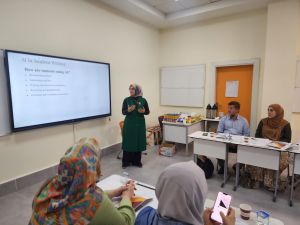
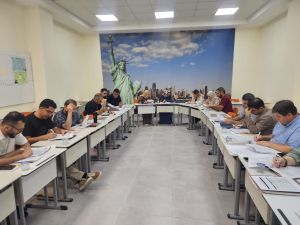
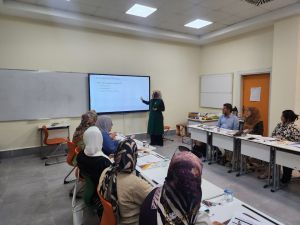
The English Language Teaching (ELT) Department, Faculty of Education, Tishk International University–Erbil, organized a National Workshop on AI Literacy and Academic Integrity on September 6, 2026, under the theme “Enhancing Teachers’ Skills in Recognizing AI-Generated Writing.” The workshop was organized by Mrs. Aivar Lukman Surji, Ms. Soma Hassan Hussein, and Assist. Prof. Dr. Aziza Kavlu and was held from 1:30 to 3:45 PM at the Faculty of Education, Tishk International University–Erbil.
The workshop focused on developing teachers’ knowledge and practical skills in recognizing AI-generated writing while promoting academic integrity and the ethical and responsible use of artificial intelligence in teaching and learning. The program combined presentations, interactive activities, practical text analysis, discussion, reflection, and hands-on recognition exercises. The workshop also contributed to SDG 4 – Quality Education, SDG 16 – Peace, Justice and Strong Institutions, and SDG 17 – Partnerships for the Goals.
Workshop Objectives
The workshop aimed to:
· Enhance teachers’ AI literacy and understanding of AI-generated writing.
· Develop practical skills for recognizing AI-generated texts.
· Promote academic integrity in the context of AI-assisted writing.
· Provide participants with opportunities to distinguish between human- and AI-generated writing.
· Explore the ethical and responsible use of AI in teaching and learning.
· Encourage critical discussion and reflection on the role of AI in education.
Key Activities
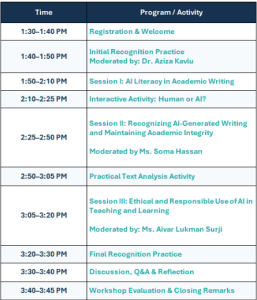
The workshop featured a variety of interactive and practical activities designed to engage participants in applying the concepts discussed throughout the sessions. These activities included Initial Recognition Practice, the interactive “Human or AI?” activity, Practical Text Analysis, and Final Recognition Practice.
Participants were given opportunities to examine written texts, identify characteristics that may indicate AI-generated writing, and reflect on the challenges of distinguishing between human- and AI-produced texts. These hands-on activities encouraged participants to apply their developing AI literacy skills in practical contexts.
The workshop also addressed key issues related to AI literacy in academic writing, strategies for recognizing AI-generated writing while maintaining academic integrity, and the ethical and responsible use of AI in teaching and learning.
The program concluded with an open discussion, Q&A session, and reflection, allowing participants to share their perspectives and experiences regarding the use of AI in education. Participants subsequently completed a workshop evaluation before the event concluded with closing remarks.
Speakers and Moderators
The workshop program included presentations, sessions, and interactive activities facilitated by members of the ELT Department. Dr. Aziza Kavlu moderated the Initial Recognition Practice, while Ms. Soma Hassan Hussein moderated Session II: Recognizing AI-Generated Writing and Maintaining Academic Integrity. Mrs. Aivar Lukman Surji moderated Session III: Ethical and Responsible Use of AI in Teaching and Learning.
Through their contributions, the organizers and moderators supported participants in developing a more informed understanding of artificial intelligence and its implications for academic writing, teaching, learning, and academic integrity.
Workshop Program Flow